Make Partner’s Job Easy
There was no time for warming up this week, as the tournament started with a bang. North–South are immediately dealt two strong hands that demand some serious slam exploration. I had the pleasure of playing with Brigid Farmer. Since it was our first time playing together and we had no special agreements, finding the slam was not entirely straightforward. But there is a way.
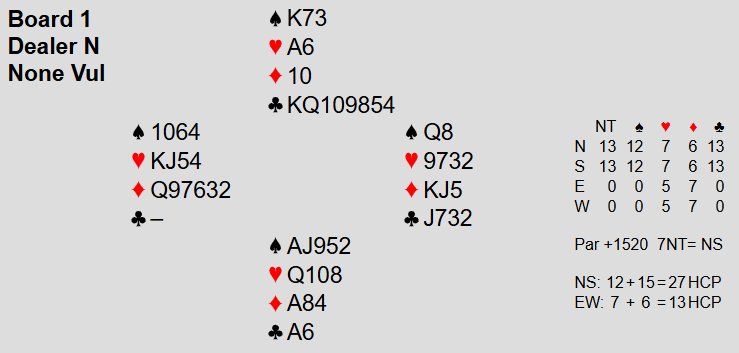
North starts with 1♣. Although the hand has only 12 HCP, it has huge trick-taking potential thanks to the club length. South, meanwhile, has a strong balanced hand with five spades. 1♠ is the standard response, but while checking the scores I noticed that quite a few of you bid 2♠ instead.
There is nothing inherently wrong with this approach if 2♠ shows a game-forcing hand with 5+ spades. There is, however, a downside: you are taking away bidding space from partner. Their next bid, now at the three-level, has to cover a much wider range of hands. The problem you solve by jumping to 2♠ can therefore create another one. Suppose opener has a stronger hand without a spade fit. There is suddenly very little room to show extra strength without going past 3NT.
You can solve this with additional agreements—perhaps 2NT shows the weaker hands and everything else is stronger, or vice versa. But unless you have some mechanism for sorting those hands out, you are giving away much of the advantage of the jump shift in the first place.
If you do play this way, North should continue with 3♠. Importantly, this should actually show more interest than jumping straight to 4♠. In game-forcing auctions we often use the principle of fast arrival: reaching game quickly says, in effect, I have nothing else to report. By slowing the auction down, North shows extra interest and leaves room to investigate.
South can now bid 4♣, showing the ace, and North can continue with either 4♦ or 4♥, depending on whether your partnership shows first-round controls only or first- and second-round controls. Either way, South should receive enough encouragement to investigate the slam and eventually reach 6♣ or 6♠.
But let’s return to the more standard auction. After 1♣–1♠, North will most likely rebid 3♣, as most of you did. This shows a stronger, unbalanced hand. The slight problem—particularly when playing with someone irregularly—is that it is not always obvious whether the bid is game forcing.
If 3♣ is only invitational, how does opener show a game-forcing hand? If it is game forcing, is North really strong enough opposite a possible six-point response? These are exactly the sort of questions worth discussing with your regular partner. There is no universal right or wrong answer. You simply need a system that covers all the possibilities.
Since I was on the receiving end of this sequence and had no idea what Brigid's exact agreement would normally be, I had to work from reasonable assumptions. Luckily, I had enough strength that game was never in doubt. My only concern was whether there might be enough for slam even if partner's 3♣ was merely invitational. I can already see the club fit. 3♣ should almost always contain six or more clubs, and if it does not, partner is likely to compensate with considerable extra strength.
The most natural bid is 3♠—show my five-card suit and let partner decide what to do next. But there is a danger. If Brigid intended 3♣ as merely invitational, she might reasonably interpret 3♠ as me signing off. She could pass, and suddenly we are playing a part-score with slam potentially available. I couldn't take that risk.
One thing I have learnt over the years playing with casual partners is this: when in doubt, choose the bid that makes partner's options obvious. Or, put another way, make it as difficult as possible for partner to make the wrong decision.
The problem I had to solve was therefore quite specific: force partner to bid again, while finding out whether we have a spade fit—preferably before going past 3NT. Can you find the solution?
We need to be slightly creative. Some might even say we need to lie, and there is a little truth in that. I bid 3♦. I don't really have diamonds. But introducing a new suit forces partner to respond and solves several problems at once. With a spade fit, partner can bid 3♠. Without one, she can make another descriptive bid. Most importantly, if I don't like what I hear, 3NT is still available.
What are the risks? The chance that partner actually has four diamonds is very small. With four diamonds and sufficient strength, North would very often have reversed into 2♦ rather than rebidding 3♣. And even if partner does have diamonds and becomes stubbornly enthusiastic about them, we still have clubs and no-trumps available as escape routes.
Brigid bid 3♠. Now we know about the double fit, and our combined strength is somewhere around 30 HCP. Those are very encouraging signs. If we can generate ten or eleven tricks from our two fitted suits alone, we only need one or two tricks from the side suits to make slam.
For me, that was enough to bid 6♠. It worked, although it is not the most precise continuation. If you want to investigate properly, 4♦ is better. Partner can then bid 4♥ with an appropriate heart control—the ♥K or ♥A, depending on your cue-bidding agreements. If partner skips hearts, 4NT is still available to check the key cards, and you can always put the brakes on in 5♠ if the news is bad.
Finding 6♠ was only half the problem. The card play turned out to be more delicate than expected. I was immediately put under pressure by a heart lead. Would you take the ♥A or play small?
I spent a few minutes trying to work out the implications. My first instinct was to take the ace, draw trumps and establish the clubs. But for that line to work, I appear to need to find the ♠Q with East. In fact, after this opening lead it is difficult to see a successful line that doesn't involve the spade position behaving.
That made me wonder whether I might as well take an extra chance in hearts first. If West has underled the ♥K, playing low gains a trick immediately. If it fails, I am essentially back where I started—I still need the spade finesse to work. So I played low. The ♥10 won in my hand. A very useful start.
The best way to play the spades is to begin by cashing the ♠K. That protects against some awkward layouts and, importantly, gives us more information before committing ourselves. Both opponents followed. Now play a small spade towards the ♠J. At this point you have controlled the suit well enough that you will not lose more than one spade trick. When the ♠Q appears, the major worry disappears.
But don't relax completely yet. Before touching clubs, take the last outstanding trump. Only then cash the ♣A. The bad club break becomes apparent, but fortunately we do not need the entire suit to run. Cash the ♣K, ruff a club, and the remaining clubs are established. You can later return to them by playing the ♥A.
Thirteen tricks in the bag.
This hand was a good reminder that partnership agreements matter, but they are not everything. Sometimes you simply cannot know exactly what partner means. In those situations, your job is not necessarily to find the theoretically perfect bid. Sometimes the best bid is the one that makes partner's next decision easy.
Our 2♣ Club winners this week are Ruth & Cristopher, and Graham & Elliott who tied with 55.56%. Well played!
If you are not already a member of 2Clubs Club, you are very welcome to join us. We play every Wednesday at 19:30 UK time.
Our session is a matchpoints tournament using preloaded hands that have already been played in an average club field, allowing you to compare your results against a typical club environment. If you get stuck during the auction, you can also call Ivan and ask for advice or clarification before making your bid.
Once you join, you will receive an email every Monday with details of that week’s tournament. Simply reply to confirm that you would like to play. We do our best to find a partner for everyone who enters — including stepping in to play ourselves whenever possible.
To join 2Clubs Club, simply email play@2clubs.club.
Session details: £8 per player. We play on RealBridge with cameras and microphones. Tournaments usually last about two hours and occasionally two and a half hours.